Pigment Red 177 vs Pigment Red 170: Which Organic Red Pigment Should You Choose?
Choosing the right red pigment is an important decision for manufacturers of coatings, plastics, masterbatch, printing inks, and other industrial products. Different organic red pigments can produce similar visual colors while offering significantly different levels of heat resistance, light fastness, weather resistance, chemical stability, and application performance.
వర్ణద్రవ్యం ఎరుపు 177 and Pigment Red 170 are two commonly considered organic red pigments. However, they have different chemical characteristics and performance profiles, making them more suitable for different applications.
For manufacturers looking for a high-performance red pigment, understanding the differences between Pigment Red 177 and Pigment Red 170 can help determine which pigment is better suited to a specific formulation and end-use application.
What Is Pigment Red 177?
Pigment Red 177, commonly abbreviated as PR177, is a high-performance organic pigment belonging to the anthraquinone pigment family. It is known for its strong bluish-red shade and excellent overall durability.
Pigment Red 177 is particularly attractive for applications where long-term color stability, heat resistance, light fastness, and weather resistance are important.
Key Characteristics of Pigment Red 177
- High-performance organic red pigment
- Excellent heat resistance
- Excellent light fastness
- Good to excellent weather resistance
- Good chemical resistance
- Strong color strength
- Suitable for demanding industrial applications
What Is Pigment Red 170?
Pigment Red 170, commonly known as PR170, is another important organic red pigment used in coatings, plastics, inks, and other coloration applications. It belongs to the monoazo pigment family and is available in different commercial grades with varying performance characteristics.
Pigment Red 170 is valued for its bright red color, good tinting strength, and broad application potential. Depending on the grade and formulation, it can provide a cost-effective solution for many general-purpose and industrial coloration applications.
Key Characteristics of Pigment Red 170
- Organic red pigment
- Bright red color shades
- Good tinting strength
- Broad application potential
- Available in different commercial grades
- Suitable for coatings, plastics, inks, and other applications
Pigment Red 177 vs Pigment Red 170: Main Differences
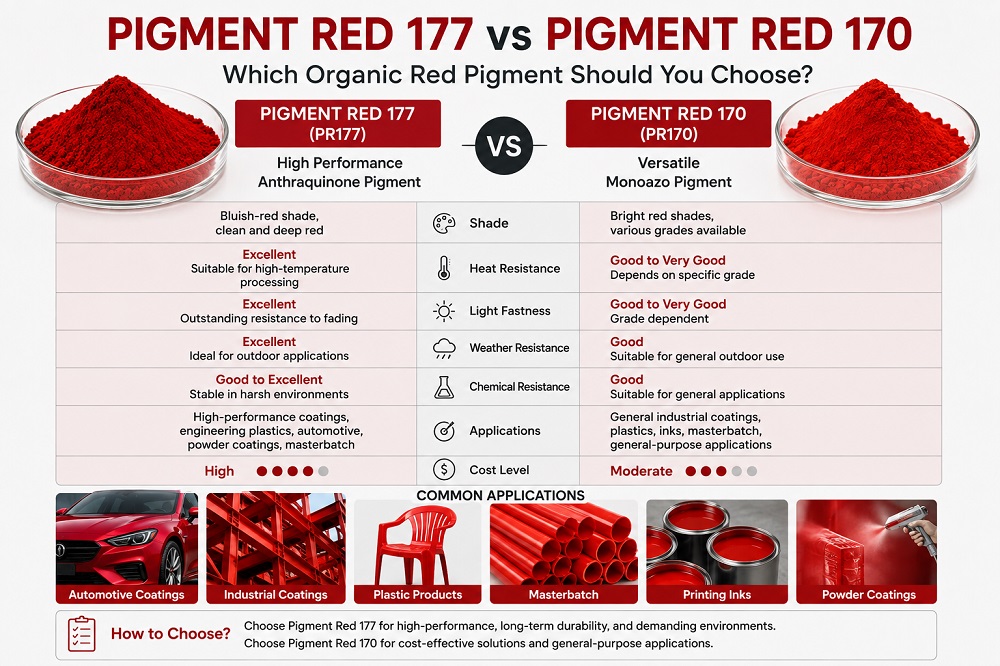
Although both pigments are used to produce red coloration, their chemical structures and performance characteristics are different. The choice between PR177 and PR170 should therefore be based on the requirements of the final product rather than simply the visual color.
రసాయన నిర్మాణం
Pigment Red 177 is an anthraquinone pigment, while Pigment Red 170 belongs to the monoazo pigment family. Their different molecular structures contribute to differences in color shade, durability, heat stability, and application performance.
Color Shade
Pigment Red 177 is generally associated with a bluish or blue-shade red, making it useful when manufacturers need a clean and relatively deep red tone.
Pigment Red 170 can offer bright red shades, although the exact color depends on the specific commercial grade, particle characteristics, formulation, and concentration.
For precise color matching, manufacturers should always evaluate the actual pigment sample against their target color standard.
ఉష్ణ నిరోధకాలు
Heat resistance is especially important for plastic coloration, powder coatings, and other applications involving elevated processing temperatures.
Pigment Red 177 is recognized as a high-performance pigment with strong thermal stability, making it suitable for demanding high-temperature applications.
Pigment Red 170 can also provide useful heat resistance, but its actual performance depends strongly on the specific grade and application conditions.
For applications involving particularly demanding processing temperatures, PR177 may be the preferred starting point when thermal stability is a major requirement.
తేలికపాటి ఉపవాసం
Light fastness determines how well a pigment maintains its original color when exposed to sunlight or other sources of ultraviolet radiation.
Pigment Red 177 offers excellent light fastness and is therefore well suited to applications where long-term color retention is important.
Pigment Red 170 can also provide good light fastness in suitable grades, but performance varies depending on the grade and formulation.
Weather Resistance
For outdoor products, weather resistance is another important consideration. Coatings and plastics may be exposed to sunlight, rain, humidity, temperature fluctuations, and atmospheric pollutants.
Pigment Red 177 is particularly attractive for demanding outdoor applications because of its strong combination of light fastness and weather resistance.
Pigment Red 170 may also be used in outdoor applications, but the appropriate grade should be selected based on the required durability level.
Chemical Resistance
Chemical resistance becomes important when the finished product may come into contact with solvents, oils, fuels, cleaning agents, or other chemicals.
Pigment Red 177 generally provides strong chemical stability and can be suitable for demanding industrial applications. Pigment Red 170 also offers useful chemical resistance, although the exact performance depends on the pigment grade and complete formulation.
Pigment Red 177 vs Pigment Red 170 for Plastics
Plastic coloration is one of the areas where pigment selection can have a significant impact on product quality. During extrusion, injection molding, and compounding, pigments may be exposed to high temperatures and strong mechanical forces.
When Pigment Red 177 Is a Good Choice for Plastics
Pigment Red 177 is a strong option when the plastic product requires excellent thermal stability, light fastness, and long-term color durability.
It can be considered for automotive plastics, engineering plastics, outdoor products, premium masterbatch, and other applications where high performance is more important than selecting the lowest-cost pigment.
When Pigment Red 170 May Be Suitable
Pigment Red 170 can be an attractive option for plastic applications where bright red coloration, good tinting strength, processing performance, and overall cost efficiency are important.
The appropriate PR170 grade should be evaluated according to the polymer system, processing temperature, required light fastness, migration resistance, and final application.
Pigment Red 177 vs Pigment Red 170 for Coatings
Coating manufacturers must consider several factors when selecting a red pigment, including color shade, gloss, transparency, opacity, light fastness, weather resistance, chemical resistance, and compatibility with the coating system.
Automotive Coatings
Automotive coatings generally require high levels of durability because vehicles are exposed to sunlight, rain, temperature changes, road contaminants, and cleaning chemicals.
Pigment Red 177 can be an excellent candidate for automotive coating systems where high-performance red coloration and long-term color stability are required.
Pigment Red 170 can also be used in automotive-related applications when a suitable high-performance grade meets the required specifications.
Industrial Coatings
Industrial coatings are used on machinery, construction equipment, metal structures, agricultural equipment, and other products that may face demanding environments.
PR177 is particularly suitable when excellent weatherability and long-term color stability are priorities.
Powder Coatings
Powder coatings require pigments with good thermal stability because the coating is typically cured at elevated temperatures.
Pigment Red 177 can be considered for high-performance powder coating applications because of its strong heat resistance and durability.
Pigment Red 170 may also be suitable for certain powder coating formulations, but manufacturers should evaluate the specific grade under actual curing conditions.
Pigment Red 177 vs Pigment Red 170 for Masterbatch
Masterbatch manufacturers need pigments that provide strong color strength, good dispersion, stable processing performance, and consistent color from batch to batch.
Color Strength
Both PR177 and PR170 can provide strong coloration, but the final tinting strength depends on pigment grade, particle characteristics, concentration, dispersion, and polymer carrier.
Thermal Stability
For high-temperature polymers, thermal stability is particularly important. Pigment Red 177 is often considered when the application requires a high-performance pigment capable of maintaining stable coloration during demanding processing.
Dispersion
Both pigments should be evaluated for dispersion in the selected carrier resin and polymer system. Good dispersion helps prevent color streaks, uneven coloration, surface defects, and inconsistent product quality.
Which Pigment Has Better Light Fastness?
There is no single answer for every commercial grade, because pigment performance depends on the specific product grade and formulation. However, Pigment Red 177 is widely recognized as a high-performance pigment with excellent light fastness.
This makes PR177 particularly attractive for outdoor coatings, automotive applications, durable plastics, and other products that require long-term resistance to fading.
When comparing a specific PR177 product with a specific PR170 product, manufacturers should request technical data and perform laboratory testing under the intended exposure conditions.
Which Pigment Has Better Heat Resistance?
Pigment Red 177 is generally a strong choice for applications where high thermal stability is required. Its high-performance pigment structure makes it suitable for demanding plastic processing and coating applications.
However, the heat resistance of Pigment Red 170 varies among commercial grades. Some specialized grades may provide good thermal stability for particular applications.
For high-temperature applications, the most reliable approach is to compare the actual technical data of the selected grades and test them under the production conditions.
Which Pigment Is Better for Outdoor Applications?
For outdoor applications, manufacturers should prioritize light fastness and weather resistance rather than color alone.
Pigment Red 177 is often a strong choice for outdoor applications because of its excellent light fastness and weather durability.
Potential applications include outdoor coatings, automotive finishes, agricultural equipment, construction products, outdoor plastic components, and other products exposed to sunlight and changing weather conditions.
Which Pigment Is More Cost-Effective?
Price should not be the only factor when comparing Pigment Red 177 and Pigment Red 170. A lower-cost pigment may not always provide the required durability for a particular application.
The total cost should consider pigment dosage, tinting strength, processing performance, product lifetime, color stability, and the potential cost of product failure or premature fading.
For General-Purpose Applications
When extreme durability is not required, Pigment Red 170 may provide an economical solution depending on the selected grade and formulation.
For High-Performance Applications
When long-term durability, heat resistance, light fastness, and weather resistance are critical, the higher performance of Pigment Red 177 may justify its use despite a potentially higher material cost.
How to Choose Between Pigment Red 177 and Pigment Red 170
The best pigment depends on the technical requirements of the finished product. Manufacturers should evaluate the following factors before making a final selection.
Consider the Required Color Shade
Determine whether the formulation requires a bluish-red, bright red, deep red, or another specific shade. Always compare actual pigment samples under standardized conditions.
Consider Processing Temperature
For plastics and powder coatings, determine the maximum processing and curing temperature before selecting the pigment.
Consider Outdoor Exposure
If the product will be exposed to sunlight for long periods, light fastness and weather resistance should receive high priority.
Consider Chemical Exposure
For industrial products, automotive components, and equipment coatings, evaluate the expected exposure to solvents, oils, fuels, cleaning agents, and other chemicals.
Consider the Polymer or Coating System
Pigment compatibility and dispersion behavior can vary depending on the resin, polymer, solvent, additives, and processing technology.
Consider Total Formulation Cost
Instead of comparing pigment prices alone, manufacturers should compare the total cost of achieving the required color and performance level.
Technical Testing Before Large-Scale Production
Laboratory testing is strongly recommended before selecting a pigment for mass production. The same pigment can behave differently depending on the formulation and processing system.
Color Strength Testing
Compare tinting strength and color shade against an approved reference standard.
Heat Stability Testing
Process the pigment under the actual temperature and residence time expected during manufacturing.
Light Fastness Testing
Evaluate color changes after controlled light exposure to determine whether the pigment meets the requirements of the final application.
Weathering Testing
For outdoor products, accelerated weathering tests can provide useful information about long-term color durability.
Migration Testing
For suitable plastic applications, migration and bleeding should be evaluated together with the complete formulation.
Why Pigment Red 177 Is a Strong Choice for High-Performance Applications
Pigment Red 177 combines several properties that are difficult to achieve with many general-purpose pigments. Its excellent heat resistance, light fastness, weather resistance, chemical stability, and attractive red shade make it a valuable choice for demanding industrial applications.
For manufacturers producing premium coatings, automotive plastics, engineering plastics, outdoor products, and high-performance masterbatch, PR177 can provide a strong balance between color performance and long-term durability.
How to Choose a Reliable Pigment Red 177 Supplier
After determining that Pigment Red 177 is suitable for the application, the next step is choosing a reliable supplier. Consistent quality is especially important when pigments are used in large-scale production.
Consistent Batch Quality
A reliable supplier should maintain stable color shade, tinting strength, particle characteristics, and other important quality parameters from batch to batch.
Technical Documentation
Buyers should request documents such as a Technical Data Sheet, Safety Data Sheet, and Certificate of Analysis before purchasing.
Application Experience
Suppliers with experience in coatings, plastics, masterbatch, and other pigment applications can provide useful technical recommendations for specific formulations.
Stable Supply Capacity
For international manufacturers, stable production capacity, suitable packaging, export experience, and reliable delivery are important factors when selecting a long-term pigment partner.
Conclusion
Pigment Red 177 and Pigment Red 170 are both useful organic red pigments, but they are not interchangeable in every application. Pigment Red 177 is particularly attractive for high-performance applications that require excellent heat resistance, light fastness, weather resistance, and long-term color stability.
Pigment Red 170 can be a suitable choice for applications where bright red coloration, good tinting strength, processing performance, and cost efficiency are important. The right choice depends on the specific pigment grade, formulation, processing conditions, and performance requirements.
For demanding industrial coatings, automotive plastics, engineering plastics, outdoor products, and premium masterbatch, Pigment Red 177 is often a strong candidate. Before large-scale production, manufacturers should compare actual pigment samples and technical data to determine which product provides the best overall performance and value for their application.
సంబంధిత ఉత్పత్తులు
 Pigment Red 177 Technical Data: Heat Resistance, Light Fastness, and Chemical Stability
- Why Pigment Red 177 Is Ideal for Plastic Coloration and Masterbatch Manufacturing
- Pigment Yellow 110: Properties, Applications, and Buying Guide for Industrial Manufacturers
- Pigment Red 146: Properties, Applications, and Technical Guide
- What Is Pigment Red 177? Properties, Applications, and Benefits Explained
- Pigment Yellow 139: Properties, Applications, and Buying Guide for Industrial Buyers
- Pigment Red 177 for Industrial Coatings: Why It Is the Preferred High-Performance Red Pigment
- How to Choose a Reliable Pigment Red 177 Manufacturer in China
- Pigment Red 177 Buying Guide: Everything Importers Need to Know Before Purchasing
- Pigment Yellow 97: Properties, Applications, and Technical Guide